



Balance
Inner Priorities
Knowing What You Need Right Now
Life pulls us in many directions. We often focus on goals, responsibilities, and expectations without stopping to ask whether our most important needs are being met.
Core-concepts
Section 5
Before we can build a balanced life, we need to understand what requires our attention. Sometimes the priority is rest. Sometimes it’s security, connection, confidence, or personal growth. When we know what we need, it’s easier to make choices that support our well-being.
Maslow’s Hierarchy provides a simple framework for reflecting on those needs. It explores five layers of human experience: our physical needs, sense of safety, relationships, self-esteem, and personal growth. This gives us a way to assess and understand what may be supporting us and what may be asking for more attention.
This section is reminder to pause and assess where your energy is currently going. What feels fulfilled? What feels neglected? Which needs are asking to be prioritized right now?
Rather than a ladder to climb, think of these needs as a compass. As life changes, our priorities shift. Returning to this framework can help us reconnect with what matters most and create a stronger foundation for everything that follows.
Maslow's Hierarchy
Maslow's theory suggests that individuals progress through these needs in a hierarchical manner, with lower-level needs taking precedence before higher-level needs become motivating factors. However, it's important to note that this hierarchy doesn't apply universally to all individuals and cultures. Some people may prioritize different needs at different stages of life, and cultural and individual variations exist.
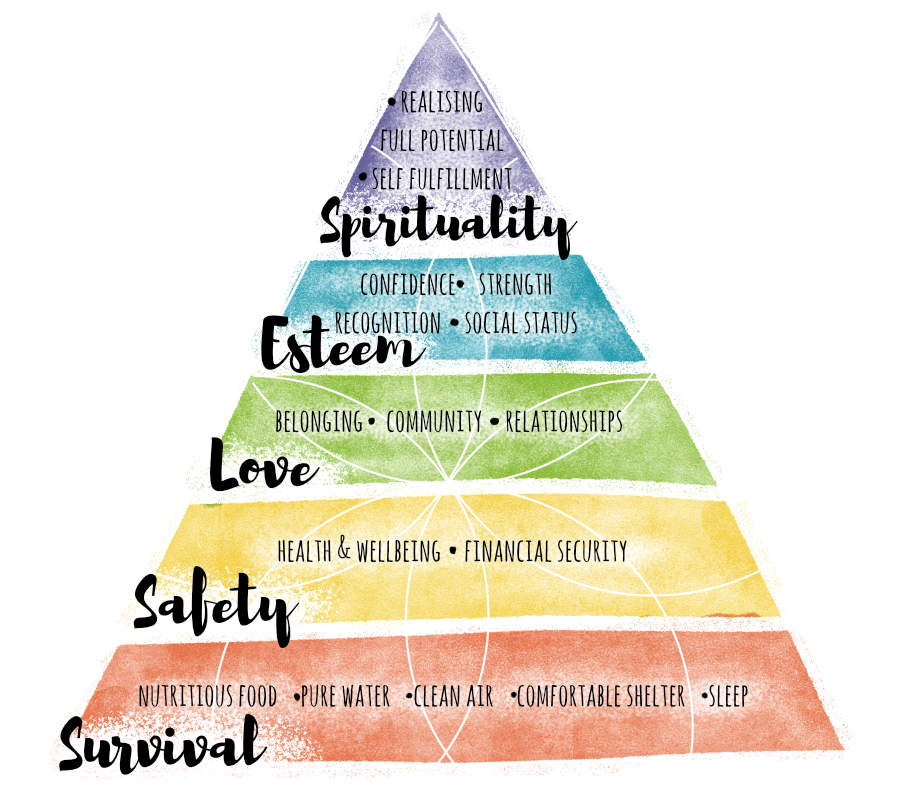
1. SUrvival Needs
These are the most basic and fundamental needs necessary for human survival.
- Food: Access to nourishment and sustenance.
- Water: Access to clean and safe drinking water.
- Shelter: Protection from the elements and a safe place to live.
- Sleep: Sufficient rest and sleep to maintain physical health.
- Air: The ability to breathe and access to clean air.
 Questions
 Questions
- Where does most of my energy go when it comes to basic needs like food, water, rest, and shelter?
- Am I maintaining a rhythm that supports my physical well-being, or am I often running on empty?
- Do I spend more time fixing problems related to survival (poor sleep, low energy, disorganized meals) than preventing them?
- Are my daily choices—meals, hydration, rest—nourishing and sustainable, or reactionary and rushed?
- What area of the survival tier is most stable for me right now? Which one feels neglected?
- What small shift could help me feel more supported or energized in this tier?
Login to view.